
Author:
Intuition PYP
Published On:
13 November 2025
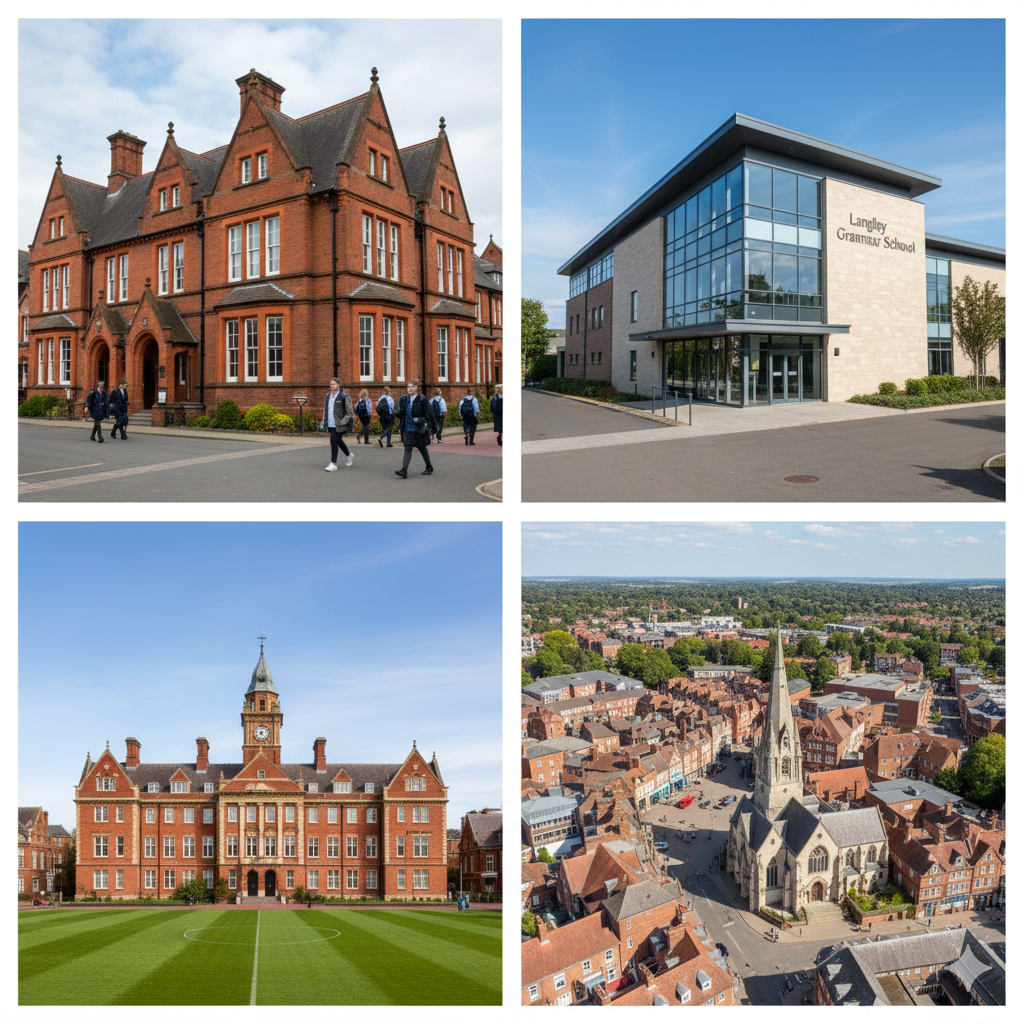
The Slough Consortium represents one of the most competitive selective school entry systems in the country. With 4,221 applications competing for just 645 grammar school places in 2023, securing a place at Langley Grammar School, Herschel Grammar School, St Bernard's Catholic Grammar School, or Upton Court Grammar School requires expert preparation, strategic planning, and consistent support.
Intuition PYP provides specialist 11 plus tutoring in Slough, designed specifically for the GL Assessment format used by the Slough Consortium. Our proven approach combines small class sizes (maximum 6 students), expert tutors with professional backgrounds, and a comprehensive curriculum that addresses every component of the Slough Consortium entrance examination.
Langley Grammar School

180 places available annually. Located in Langley, this co-educational selective school consistently ranks among the top performing schools in Berkshire. Langley Grammar's academic results place it in the top tier of grammar schools nationally, with excellent progression to Russell Group universities.
Herschel Grammar School

150 places available. Situated in Slough, Herschel Grammar is a girls' selective school with an outstanding reputation for academic achievement and pastoral care. The school's focus on developing confident, articulate young women has established it as one of the most sought-after grammar schools in the region.
St Bernard's Catholic Grammar School

150 places available. This co-educational Catholic grammar school in Langley requires evidence of Catholic faith for admission. St Bernard's combines academic excellence with strong Catholic values, creating a distinctive educational environment. Priority is given to practicing Catholic families, though the academic threshold remains equally demanding.
Upton Court Grammar School

165 places available. Based in Slough, Upton Court is a co-educational grammar school with a strong community ethos. The school's comprehensive approach to education balances academic rigour with extensive extracurricular opportunities, producing well-rounded students who excel across multiple domains.
The numbers tell a challenging story:
These statistics demonstrate why professional 11 plus tutoring in Slough isn't optional—it's essential. Without expert preparation, even bright students struggle to compete effectively in this intensely competitive environment.
The Slough Consortium uses GL Assessment tests, which differ significantly from other selective school examination formats. Understanding these differences is crucial for effective preparation.
English – Comprehension passages, grammar, punctuation, spelling, and vocabulary. The English paper assesses reading comprehension at a sophisticated level, requiring students to analyse texts critically, identify implicit meanings, and demonstrate advanced grammatical understanding.
Mathematics – Number operations, fractions, decimals, percentages, algebra basics, geometry, and problem-solving. The Mathematics component tests both procedural fluency and conceptual understanding, with multi-step problems requiring logical reasoning and systematic approaches.
Verbal Reasoning – Word relationships, analogies, codes, sequences, and logical deduction. Verbal Reasoning challenges students to identify patterns in language, manipulate words according to complex rules, and demonstrate flexible thinking across various question types.
Non-Verbal Reasoning – Pattern recognition, spatial awareness, sequences, and visual logic. Non-Verbal Reasoning assesses abstract thinking through visual puzzles, requiring students to identify rules governing shape transformations, complete matrices, and recognize rotational patterns.
Pass Mark: 111 – This is the minimum standardised score required to be considered for admission. However, achieving exactly 111 rarely results in an offer due to intense competition.
Recommended Target: 120+ – Students scoring 120 or above have significantly stronger chances of receiving offers. For the most competitive schools within the consortium, scores approaching 125+ may be necessary.
Standardisation Process – GL Assessment uses age-standardisation, meaning raw scores are adjusted based on the student's age within their year group. A younger Year 6 student receives credit for their age, while older students face slightly higher thresholds. This system ensures fairness across the age range but adds complexity to score interpretation.
GL Assessment tests differ from CEM (Durham University) tests in several critical ways:
Students prepared exclusively for CEM-style tests perform poorly on GL Assessment papers. This is why specialist 11 plus tutoring in Slough must focus specifically on GL Assessment preparation rather than generic 11 plus content.
Understanding the timeline is essential for strategic preparation.
September - December – Begin foundational preparation. Introduce basic Verbal and Non-Verbal Reasoning concepts while strengthening English and Mathematics core skills. This period focuses on building confidence and establishing effective study habits.
January - March – Intensify preparation. Expand reasoning question types, increase practice volume, and introduce timed conditions. Students should complete full practice papers under exam conditions by March.
April - July – Consolidate learning and address weaknesses. Refined practice focusing on individual areas requiring improvement. By July, students should demonstrate consistent performance across all test components.
May 1 - June 5 – Registration window opens. Parents must register online through the Slough Consortium website. Late registrations are not accepted under any circumstances. Ensure you register before the deadline—thousands of families miss this critical window annually.
June - September 19 – Final preparation intensive. This crucial period separates successful candidates from those who fall short. Intensive practice, exam technique refinement, and confidence building become the focus. Students should complete multiple full practice papers weekly.
September 20 – Examination day (date varies slightly year to year). Students sit the GL Assessment tests at their designated test centre. The examination typically takes place on a Saturday morning, with students completing all four papers in a single session.
October – Results released. Parents receive standardised scores and pass/fail notification. Scores are typically released in mid-October, approximately 3-4 weeks after the examination.
October - February – Secondary application process. Parents list grammar schools as preferences on their local authority secondary school application form. This is separate from the Slough Consortium registration and equally critical.
March 2 – National Offer Day. Students receive their secondary school allocation. Grammar school offers are made to students who achieved qualifying scores and listed the schools as preferences on their application.
Many parents initially attempt 11 plus preparation independently using workbooks and online resources. While well-intentioned, this approach rarely produces competitive scores in the Slough Consortium system.
Expert Knowledge of GL Assessment – Our tutors understand precisely what GL Assessment tests assess and how questions are constructed. This insider knowledge allows us to teach strategies that significantly improve performance on test day.
Systematic Skill Development – Verbal and Non-Verbal Reasoning aren't subjects taught in primary school. These reasoning skills require systematic instruction from professionals who understand cognitive development and can explain complex patterns in age-appropriate ways. Our tutors include former doctors and dentists—professionals accustomed to teaching complex reasoning to high standards.
Identification of Weaknesses – Parents often struggle to identify exactly where their child's understanding breaks down. Our diagnostic approach pinpoints specific gaps, allowing us to address them efficiently rather than wasting time on areas already mastered.
Exam Technique Mastery – Achieving a high score isn't just about knowledge—it's about technique. Time management, question selection, educated guessing strategies, and stress management all contribute to final scores. These techniques are taught explicitly in professional tuition but rarely addressed in independent study.
Accountability and Momentum – Regular tuition sessions create accountability that maintains preparation momentum. Without structured sessions, preparation often becomes sporadic and insufficient.
Intuition PYP limits class sizes to just 6 students maximum. This isn't an arbitrary number—it's based on educational research demonstrating optimal learning conditions.
Why 6 Students vs. Competitors' 8-12?
Competitors with classes of 8-12 students might claim similar quality, but the mathematics tells a different story. A tutor with 12 students spends half as much time with each child as a tutor with 6 students—that difference compounds over an academic year into significantly inferior outcomes.
Understanding what differentiates exceptional tuition from adequate tuition helps parents make informed decisions.
Class Size
Tutor Qualifications
Curriculum Specificity
Progress Monitoring
Flexibility
Diagnostic Assessment
The difference compounds over months of preparation, resulting in scores typically 5-8 points higher than students receive from standard tutoring centres.
We offer a comprehensive, no-obligation assessment identifying your child's current ability level across all four GL Assessment components.
Verbal Reasoning Test – diagnostic questions assessing vocabulary, word relationships, and logical deduction skills.
Non-Verbal Reasoning Test – diagnostic questions evaluating pattern recognition, spatial awareness, and abstract reasoning.
English Sample – Comprehension passage with questions plus grammar and vocabulary assessment.
Mathematics Sample – Mixed problems evaluating procedural skills and conceptual understanding.
Detailed Report – Written analysis identifying strengths, weaknesses, and recommended preparation pathway.
Consultation – Discussion with an experienced tutor explaining results and answering questions.
The assessments can be scheduled on preferred timings either on weekends or weekday evenings to suit working parents.
When should we start 11 plus preparation?
Ideally, begin in September of Year 4 or at the latest, September of Year 5. This provides 12-18 months of preparation, which research shows optimises results. Starting later is possible but requires intensive effort and limits how much improvement can be achieved.
Can bright students pass without tutoring?
Occasionally, yes—but it's increasingly rare in the Slough Consortium where competition is extreme. Even naturally gifted students benefit from exam technique coaching and practice with GL Assessment specific formats. The risk of not tutoring is substantial given the high stakes.
How much practice is needed weekly?
During Year 5, 3-4 hours weekly (including tuition session) is typical. This increases to 5-6 hours weekly in Year 6, particularly in the final term. Quality matters more than quantity—focused, purposeful practice beats mindless repetition.
What if my child attends a tutoring centre already?
Evaluate their progress objectively. If scores aren't improving after 2-3 months, consider alternatives. The quality difference between tutoring centres is substantial—not all preparation is equally effective.
Is the Slough Consortium harder than other areas?
GL Assessment tests used by Slough Consortium are comparable in difficulty to other GL areas like Buckinghamshire. However, the competition ratio (15% success rate) makes Slough particularly challenging. Strong preparation is essential regardless of your child's natural ability.
Do you offer trial sessions?
Yes, new students can attend one trial session before committing to full term enrolment. This allows students to experience our teaching approach and class environment before making a decision.
The Slough Consortium 11 plus examination represents a significant challenge, but with expert preparation, your child can compete effectively for those 645 available places.
Intuition PYP provides the specialist GL Assessment preparation Slough families need to succeed. Our small class sizes, expert tutors, and proven curriculum have helped hundreds of students secure grammar school places at Langley Grammar, Herschel Grammar, St Bernard's, and Upton Court.
Book your free 11 plus readiness assessment today.
Call us or book online at our website. Weekend and evening appointments available.
Don't leave your child's education to chance. Professional 11 plus tutoring in Slough makes the difference between success and disappointment. Contact us now to begin your child's journey to grammar school.
Book a free consultation now and discover how our tailored tutoring can make a difference.